
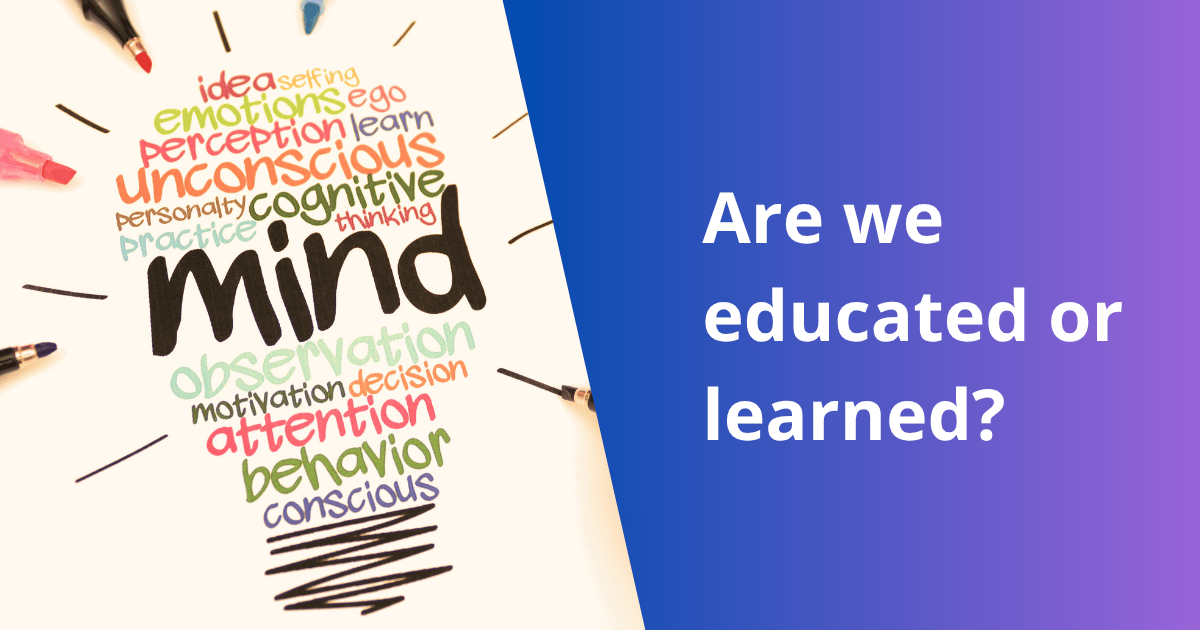
Are We Educated or Learned?
Education is usually measured in years, marks, degrees and certificates. Learning is more inconvenient. It must be measured through judgement, curiosity, adaptability and behaviour—qualities that cannot be laminated and hung on a wall.
A person may spend twenty years in educational institutions and still panic when confronted with a question for which there is no answer at the back of the textbook. Another may possess fewer qualifications but understand people, situations and consequences with remarkable clarity.
One has been educated. The other has learned.
The difference is important because education can prepare us to pass an examination, while learning prepares us to face life after the examination—which is unfortunate, because life refuses to provide multiple-choice answers.
The Examination Factory
The Indian education system has been debated for decades by parents, teachers, students, policymakers and television experts who can redesign the entire system between two commercial breaks.
Parents complain about fees. Students complain about pressure. Teachers complain about administration. Institutions complain about regulation. Governments appoint committees. Committees prepare reports. Reports recommend new committees.
The system survives every reform with admirable resilience.
Its primary achievement is the examination—a ritual through which we test how accurately a young person can reproduce information under conditions of fear, sleep deprivation and parental expectation.
A student who memorises the textbook is declared intelligent. A student who questions it may be declared distracted. A student who finds a better answer than the prescribed one risks losing marks for unauthorised imagination.
We say we want children to think independently, but only after they have written exactly what the examiner expected. The examination system does not always reward understanding. It rewards obedience with good handwriting.
Students learn early that the safest answer is not necessarily the most intelligent one. It is the one appearing in the guidebook. Thus begins their preparation for corporate life, where the safest opinion is often the one already held by the person conducting the meeting.
The Coaching Republic
Wherever an education system produces anxiety, an industry soon arrives to monetise it.
Welcome to the coaching economy.
Coaching institutions promise to transform ordinary children into examination-commandos capable of attacking question papers with military precision. Their advertisements display smiling toppers, dramatic percentages and heroic claims. Every successful student appears to have studied at six coaching centres simultaneously, each of which takes complete credit.
The coaching centre does not merely teach the subject. It reverse-engineers the examination.
Students are trained to recognise patterns, eliminate options, predict likely questions and calculate how much knowledge can be safely ignored. Understanding is useful, but only if it does not interfere with speed.
The child learns that education is not about discovering the world. It is about defeating a three-hour paper designed by strangers.
Parents join the operation enthusiastically. Childhood becomes a project plan. Recreation becomes a scheduling failure. Curiosity is permitted only when it is relevant to the entrance examination.
By the age of seventeen, the student may know how to solve an advanced mathematical problem in ninety seconds but may be unable to ask a shopkeeper a question without looking at a parent for approval.
We have created a system where young people are over-instructed, over-evaluated and often underexposed to life.
Memorisation, as I have often felt, is what we resort to when what we are learning makes no sense.
What Recruitment Interviews Reveal
I have frequently encountered the consequences of this system while interviewing candidates for positions in my company.
Candidates arrive with degrees, certificates, internships and résumés carefully polished until all traces of personality have been removed.
Almost everyone is “passionate,” “dynamic,” “results-oriented” and eager to work in a “challenging environment.” Apparently, no graduate has ever wanted a calm environment with reasonable working hours.
Their résumés announce leadership qualities developed while organising a two-hour college event. Their objectives promise to contribute to organisational growth while developing their own potential in a professionally stimulating ecosystem.
This language proves that the management-degree industry has succeeded in teaching students how to say very little using a great many words.
During interviews, I try to move beyond rehearsed answers. I ask candidates about society, customer behaviour, personal choices, business trends and situations without obvious solutions. I explore how they form opinions, deal with disagreement and interpret change. The purpose is not to examine whether they remember what they studied. It is to discover whether studying has altered how they think.
Some candidates possess impressive qualifications but struggle to connect ideas. They know definitions but cannot read situations. They can explain customer satisfaction but fail to notice that the receptionist they just ignored is also a human being.
They have information without perception, confidence without clarity and ambition without direction. The damage is subtle.
Our education system often prepares young people to seek approval rather than insight. They wait for the correct answer, the correct process and the correct authority. When faced with ambiguity, they look around for an invigilator.
Corporate Recruitment: The Second Examination
Corporate recruitment claims to search for originality, creativity and independent thinking.
It begins by filtering candidates according to marks, institutions, keywords and standardised aptitude tests.
Companies proudly announce that they want people who can “think outside the box.” They then reject everyone who does not fit neatly into the box created by the recruitment software.
The first interview assesses communication. The second assesses technical knowledge. The third assesses cultural fit. The fourth introduces the candidate to a senior executive who has not read the résumé. The fifth may determine whether the candidate is sufficiently enthusiastic about the salary already decided by the company.
Candidates are asked where they see themselves in five years, although many organisations cannot predict where their own industry will be in eighteen months.
They are asked to describe their greatest weakness. The correct response is usually a disguised strength: “I am too committed,” “I work too hard,” or “I care excessively about quality.”
Nobody says, “My greatest weakness is answering artificial questions dishonestly because I need the job.”
Recruitment has become résumé theatre. Candidates perform employability. Interviewers perform objectivity. Everyone uses phrases like “leadership potential,” “strategic mindset” and “cultural alignment,” after which the final decision may depend on whether someone reminds the panel of an employee who left badly in 2017.
The Management-Degree Miracle
Management education deserves special recognition for converting ordinary language into premium terminology.
A problem becomes a “challenge.” A delay becomes a “timeline recalibration.” Firing employees becomes “rightsizing.” Copying a competitor becomes “benchmarking.” Guessing becomes “scenario planning.” And an idea that no one understands becomes “strategic.”
The MBA—sometimes affectionately interpreted as the Master of Business Administration—can occasionally resemble a Master of Business Acronyms.
Students learn SWOT, PESTLE, BCG, KPI, ROI and enough alphabetic weaponry to frighten anyone running an actual business.
Frameworks have value. But frameworks are maps, not territories. A person can analyse a retail business through five models and still fail to notice that customers are leaving because the trial room is dirty and no salesperson is available.
A management graduate may produce a forty-slide presentation on customer engagement. An experienced retailer may simply notice that a customer has been standing alone for seven minutes.
The graduate has a framework. The retailer has eyesight.
Real business learning occurs when theory meets consequence. Pricing is understood when a customer refuses to buy. Inventory is understood when cash is trapped in unsold stock. Leadership is understood when employees stop telling the manager the truth.
No case study can fully reproduce the discomfort of making a decision with incomplete information and living with the result.
Experience: Years or Repetition?
When I interview a candidate, I try to imagine how that person might look back after several years of work.
Will the individual have ten years of experience? Or one year of experience repeated ten times?
Time spent at work does not automatically become wisdom. Some professionals accumulate insight. Others accumulate anniversaries.
A learned individual reflects: What changed? What failed? What did the customer actually want? Which assumption proved wrong? What should be done differently?
An educated person may defend the procedure. A learned person examines the result.
I once met a candidate who described his experience in days rather than years. It initially sounded unusual. Then I remembered Tom Peters’ description of the “nanosecond nineties”—an age in which change was becoming too rapid for traditional measures.
Perhaps the candidate had understood the spirit of the times. In modern business, products, technologies and consumer preferences can complete an entire lifecycle while a large corporation is still scheduling the committee meeting to discuss them.
Experience measured only in years may indeed be passé. The real measure is how often we have noticed, questioned, adapted and evolved.
The Evolution We Need
Education should not merely produce employable graduates. It should produce observant human beings.
It should teach people to entertain an idea without immediately accepting or attacking it. It should encourage them to recognise the limits of their knowledge, change their opinion when evidence changes and distinguish confidence from competence.
A learned person does not assume that every senior executive is wise, every policy is sensible or every presentation containing a pyramid is strategic.
The evolution of education will begin when questions are valued as much as answers, practical intelligence is respected alongside academic achievement, and institutions stop confusing examination performance with human potential.
It will begin when coaching centres help students understand rather than merely outperform, when management schools produce decision-makers rather than jargon distributors, and when recruiters seek curiosity instead of rehearsed compatibility.
Education may open the door. Learning tells us whether the room is worth entering.
So the question remains—not only for students and teachers, but for parents, recruiters, managers and ministers:
Are we educated, or are we learned?
Our degrees can answer the first question. Only our behaviour can answer the second.
Long live the nanosecond age—where knowledge expires quickly, jargon travels instantly, and wisdom is still waiting outside the examination hall because it forgot to bring its admit card.