
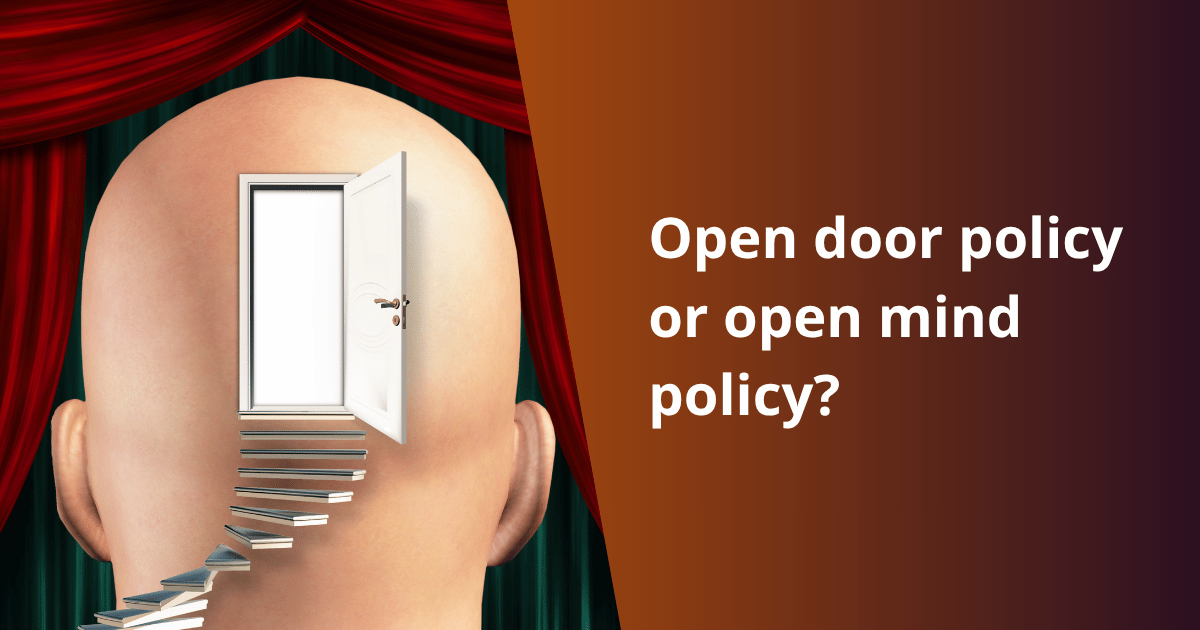
Open Door Policy or Open Mind Policy?
Some years ago, I attended a presentation organised by McCann at one of my former employers, where I worked for a period as Head of Marketing. The subject was appropriately grand: “The Value of Brands.”
As expected, the room was full of intelligent people, carefully designed slides and complicated diagrams explaining simple human behaviour. There were circles inside triangles, arrows pointing towards consumers, and several words that could only be understood after hiring another consultant.
The speaker concluded confidently:
“At McCann, we have an open-door policy. We encourage you to express your honest feedback on the brand-positioning strategy we have recommended.”
It was a generous invitation.
After he left, I heard two people in the front row whispering sarcastically:
“Of course, they have an open-door policy—as long as you enter through the door carrying compliments and leave your criticism outside.”
That brief exchange captured an uncomfortable truth about many organisations. The door may be physically open, but the mind sitting behind it is often securely locked, bolted and protected by designation.
We have all known leaders like this.
They announce that employees may approach them at any time. They encourage “frank dialogue”, “constructive disagreement” and “fearless communication”. These phrases are usually displayed on posters near the reception area, where they can cause the least damage.
The actual message is often different:
“My door is open. Please come in and confirm that I am right.”
Managers frequently say they welcome criticism, but their faces suggest that criticism should arrive in gift wrapping. A contrary opinion can suddenly affect your “attitude score”, your performance appraisal and, in extreme cases, your visibility at the annual conference.
An open door is easy. It requires hinges. An open mind is more difficult. It requires humility.
The Brainstorm That Lost Its Brain
During my time at Kinetic Honda, my manager once scheduled a brainstorming meeting on the subject of increasing scooter sales through indirect channels.
He told me that he wanted to “tap my brain”.
This was encouraging, although also slightly alarming. In the previous two years, he had never asked for my opinion on anything, despite my having exceeded sales targets in some of the toughest territories of Northeast India.
I should have been suspicious. When a manager who has ignored your experience for two years suddenly wishes to tap your brain, you must first check whether he intends to use it or merely needs a decorative object for the meeting.
Still, I prepared seriously. I gathered field observations, channel ideas and practical suggestions. I was excited that perhaps my manager had turned over a new leaf.
The brainstorming session began. Within a few minutes, he fell asleep.
My colleagues continued enthusiastically, apparently believing that leadership can remain present in spirit even when it has departed physically.
There we were, storming our brains while the main brain enjoyed peaceful weather.
Perhaps that was his management technique. Maybe he believed that the best way to encourage free expression was to remain oblivious!
I had entered the meeting with great expectations. Watching him sleep through my carefully prepared ideas was a considerable blow. I finally excused myself and left, trying to appear professional rather than personally offended by his successful demonstration of deep corporate meditation.
That experience taught me something important. Many leaders do not really want ideas. They want participation. The meeting must happen. The attendance sheet must circulate. People must speak. Minutes must be prepared. A presentation must be emailed. Then everybody can return to doing exactly what they were already doing.
The ritual of consultation is completed without suffering the inconvenience of listening.
Listening Without Preparing a Defence
An open-minded manager listens to ideas, opinions and criticism without immediately becoming defensive. Such a person does not treat disagreement as disloyalty or a question as an attempted coup.
Authority has a strange effect on human behaviour. Once people receive impressive titles, larger cabins and assistants who manage their calendars, they may begin to believe that wisdom was included in the promotion package. It was not.
No individual, irrespective of designation, experience or expertise, has a monopoly on correct thinking. Wisdom is usually scattered across an organisation. A little of it may sit in the boardroom, some in the sales office, some on the shop floor and a great deal beside the customer-service telephone.
Unfortunately, organisations often listen in reverse order of usefulness. The people farthest from the customer speak first. The people closest to the problem speak last—if they are invited at all.
The Toothpaste Solution
A well-known business story illustrates this perfectly.
A prestigious toothpaste company was experiencing a steady decline in sales. The fall was not catastrophic, but it was persistent enough to alarm senior management.
The company responded in the traditional corporate manner.
It launched incentive schemes. It conducted reviews. It held strategy meetings. Senior executives visited customers. Salespeople were encouraged, pressured, retrained and probably shown motivational videos featuring mountain climbers. Nothing worked.
Quarter after quarter, sales continued to fall.
Before yet another meeting, the vice-president of sales went to the washroom to refresh himself, which was possibly the only refreshing part of the strategy process.
There, he bumped intoa recently hired production intern. In the short casual conversation, the vice-president mentioned the sales problem and complained that the sales force needed to push harder.
The intern listened and suggested:
“Why don’t we increase the opening of the toothpaste tube? People will squeeze out slightly more toothpaste each time. Consumption may rise, creating additional demand from existing customers. It could give the company some breathing space while it develops a broader solution.”
The vice-president was stunned.
“Why didn’t you suggest this earlier?” he asked. The intern replied: “Nobody asked me.”
Whether treated as a literal case or a management parable, the story makes its point beautifully. Organisations may spend millions searching for solutions while ignoring the people who see the problem every day.
The consultant prepares a 90-slide deck. The intern notices the tube. The senior team analyses consumer behaviour. The retail employee has already heard the consumer explain it fifty times. The board discusses “friction in the customer journey”. The cashier knows that the billing software freezes whenever two discount schemes are applied together. The warehouse worker knows why dispatches are delayed. The salesperson knows why dealers are not ordering. The tailor knows why customers reject a particular fit. The customer-care executive knows which product promise is repeatedly failing.
But these people are often not invited to the meeting because they lack the correct designation.
Corporate intelligence frequently travels upward through so many filters that, by the time it reaches leadership, it has become polite, harmless and useless.
Designations Versus Functions
Many businesses remain trapped between designations and functions.
A designation tells us where someone sits in the hierarchy. A function tells us what someone actually knows and contributes. The two are not always related.
A junior retail associate may understand customer behaviour better than the regional manager. A delivery executive may understand packaging failures better than the brand team. A production worker may identify wastage that several rounds of cost consultants have missed.
Yet organisations often assume that ideas become intelligent only after travelling upwards. This is why meetings are filled with people authorised to speak rather than people qualified to answer.
In retail, for example, a store owner may wonder why a premium range is not moving. The merchandising team may blame pricing. Marketing may blame visibility. Sales may blame customer awareness.
Meanwhile, the salesperson on the floor knows the actual reason: customers like the fabric but dislike the available colours.
The problem is not complex. It has merely been protected from simplicity by management.
The Family Boardroom
The same principle applies outside business.
Families also proudly operate open-door policies. Parents tell children, “You can tell us anything.”
The sentence often contains an invisible footnote:
“Provided it matches our values, confirms our expectations and does not embarrass us before relatives.”
Partners ask for honesty and then punish the honest answer. Friends claim to welcome advice but prefer endorsement. Social groups celebrate individuality until someone behaves individually.
Human beings do not merely want to be heard. We also want reality to agree with us.
An open mind therefore requires more than listening politely. It requires the willingness to be changed by what we hear. That is the true test.
A leader who listens to ten opinions and then automatically follows the original plan has not practised openness. He has merely conducted an elaborate ceremony before ignoring everyone.
Open the Mind First
An open-door policy may make leadership appear accessible. But accessibility without receptiveness is theatre.
Employees do not need symbolic permission to enter a cabin. They need psychological permission to speak honestly once they are inside.
They must know that questioning an idea will not be mistaken for questioning authority. They must be able to report a problem without becoming the problem. They must be allowed to disagree without being described as “negative”, “not aligned” or “lacking executive maturity”.
Great organisations do not merely collect opinions. They create an environment where truth can travel without wearing a disguise. The next breakthrough may come from a senior strategist. It may also come from an intern, a salesperson, a machine operator, a store assistant—or someone accidentally encountered near the washroom.
Leadership is not demonstrated by having all the answers. It is demonstrated by recognising that the answers may be sitting in people whose names do not appear on the organisation chart in bold letters.
So, by all means, keep the door open.
But before announcing the policy, check the mind behind it. Otherwise, people may enter, express themselves and leave with the uncomfortable feeling that they have been speaking to a well-furnished wall.