
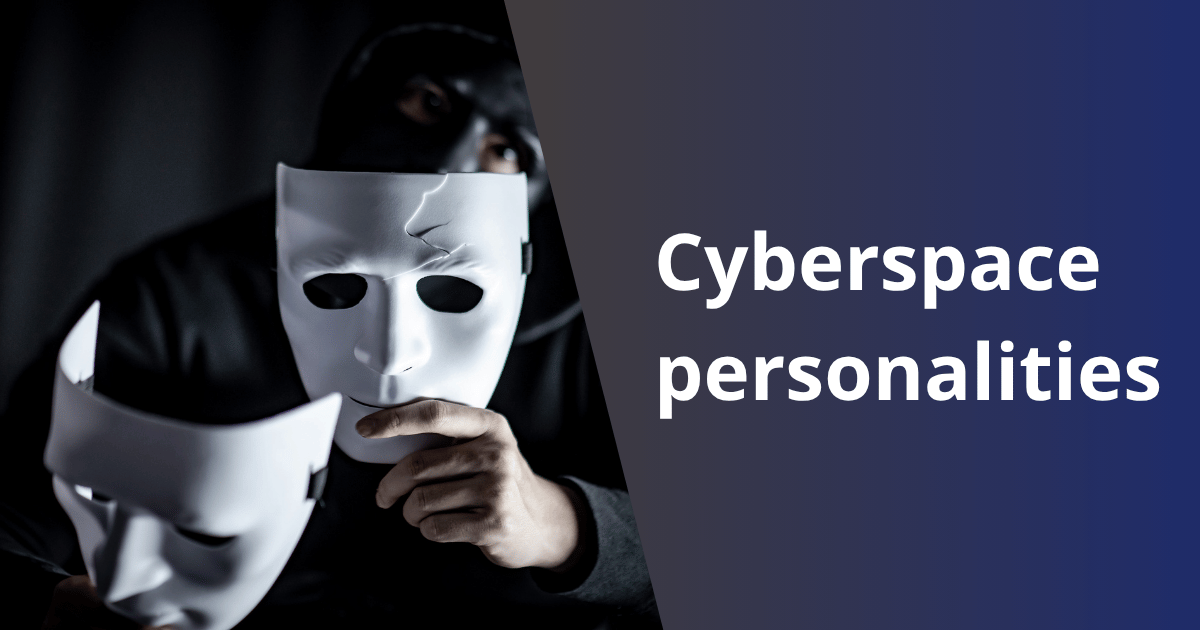
Cyberspace Personalities
The inspiration for this post came from a brief conversation with my daughter. She was preparing to open a Facebook account and begin interacting with her friends—or, as I insisted on calling them, cyberspace personalities.
Like most cautious parents, my wife and I gave her a short introduction to online safety, digital identities and the possibility that the cheerful fourteen-year-old at the other end of a conversation might actually be a forty-seven-year-old insurance agent experimenting with youthfulness.
I tried to explain that the internet is not necessarily populated by the people it claims to contain.
She listened politely. At least, I assumed she was listening. Her eyes were open for the first few minutes.
The conversation raised a larger question: Who exactly are we interacting with in cyberspace?
Are online personalities accurate representations of real people? Or are they carefully designed characters—edited, filtered, branded and occasionally manufactured with more imagination than evidence?
The Great Online Costume Party
One of the most fascinating features of the internet is that it gives us an opportunity to present ourselves not merely as we are, but as we would like to be seen.
In ordinary life, reality is annoyingly persistent. Our age is visible, our habits are known, our wardrobe has witnesses and our family remembers what we were doing before we became “visionary thinkers.”
Cyberspace is more generous.
Online, a person can modify age, history, profession, appearance, personality and even gender. A username can suggest mystery. A photograph can suggest glamour. A biography can suggest achievement. None of these suggestions are legally obliged to meet reality.
A person who has never managed anything more complicated than a family WhatsApp group may describe himself as a “leadership strategist.” Someone who has read two articles on artificial intelligence may become a “futurist.” And a manager whose team is quietly updating its résumés may publish daily lessons on employee engagement.
This is called personal branding. In less sophisticated times, it was called exaggeration.
The internet has transformed identity into a product. We now package ourselves much like companies package soap, shirts and breakfast cereals. We select the right photograph, write a flattering description, display carefully chosen opinions and quietly remove any evidence that might disturb the positioning.
The modern online personality is not always false. It is simply edited with the enthusiasm of a government report.
One Person, Several Avatars
Every human being has multiple dimensions. We are parents, professionals, friends, customers, citizens, hobbyists and occasional philosophers after two drinks. Cyberspace allows us to separate and amplify these different identities.
A successful banker on Dalal Street may prefer to be known online as a musician. A reserved accountant may become a fearless political commentator after dinner. A senior executive who says very little during meetings may become astonishingly articulate on LinkedIn, especially after someone else has already solved the problem.
This freedom is not necessarily harmful. The internet can provide space for parts of our personality that remain hidden in everyday life. A person trapped in a rigid professional identity may discover a creative community online. Someone who is shy in physical settings may communicate more confidently through writing.
The difficulty begins when the avatar stops expressing the person and starts replacing the person.
We begin by creating an online image. Soon, we are working full-time to protect it. The fitness enthusiast cannot admit to eating a samosa. The motivational speaker cannot confess to feeling lost. The business guru cannot reveal that last quarter was disastrous. The happiness influencer must continue smiling even while the ring light is overheating and the landlord is calling.
The brand has acquired an employee—and the employee is us.
Every Message Carries a Value
The way people communicate online reveals more than they realise.
Their choice of words, their reaction to disagreement, the speed with which they become offended and their decision to remain silent all reflect their values.
A person’s online behaviour is a kind of psychological balance sheet. Some communications add value: curiosity, humour, empathy and reason. Others create liabilities: aggression, vanity, prejudice and the irresistible desire to correct strangers at midnight.
Even silence communicates. A person may ignore a cruel comment but react furiously to a spelling mistake. Another may remain quiet during a serious discussion yet become passionately involved when someone criticises his favourite cricket team.
We can almost assign mathematical values to these interactions. A thoughtful response adds something positive. A personal attack subtracts from the conversation. Ten people repeating the same fashionable opinion may create volume without creating value—rather like certain management meetings.
But the calculation is rarely simple. A cheerful emoji can conceal irritation. A polite sentence may be carrying a knife. “Thank you for sharing your perspective” can mean anything from genuine appreciation to “I hope your Wi-Fi fails permanently.”
Earth, Heaven and the Cloud Between Them
Online communication exists somewhere between reality and fantasy.
Some users remain firmly on earth. They present ordinary lives with reasonable honesty. They admit uncertainty, change their opinions and occasionally post photographs in which their faces still resemble them.
Others operate closer to heaven. Their careers are always advancing. Their children are permanently brilliant. Their holidays are spiritual journeys. Their marriages are partnerships of eternal growth. Even their morning coffee carries a lesson in leadership. Nothing ever goes wrong—except when it becomes “an opportunity for transformation.”
The same performance occurs in business.
Companies describe layoffs as “workforce optimisation.” A failed product becomes a “valuable learning experience.” A shop that has run out of stock announces “unprecedented customer demand.” A retailer increases prices and calls it a premium repositioning exercise.
The language of cyberspace allows reality to be dressed for presentation.
Imagine a clothing store posting online: “Our customers are embracing minimalist consumption.” The truth may simply be that nobody bought the new collection.
Both sentences describe the same afternoon. Only one is suitable for a board presentation.
The challenge is therefore not merely to decide whether something is true or false. It is to understand how much reality has been diluted by presentation.
Motives Beneath the Profile
People do not always consciously choose the identities they create online. Hidden wishes, insecurities and unmet needs often leak through.
A constant demand for admiration may reveal loneliness. Aggressive certainty may conceal doubt. Repeated displays of success may be attempts to persuade the person posting them as much as the audience reading them.
Some people use cyberspace to become better versions of themselves. They learn, create, collaborate and connect across boundaries that would otherwise restrict them.
Others use it to avoid themselves.
Anonymity can liberate, but it can also remove accountability. People who are courteous in person may become cruel online because the screen creates emotional distance. They say things to strangers that they would never say across a dining table—partly because the stranger might throw the dining table at them.
The internet also offers access to an almost unlimited audience. For certain personalities, this becomes intoxicating. Every post is a performance, every comment is applause and every disagreement is an attack on the empire. The result is not communication but continuous campaigning.
Text, Voice and Image
In physical life, we express identity through clothing, body language, work, hobbies and relationships. In cyberspace, we choose different media.
Some people prefer text because it gives them time to edit their thoughts—and occasionally manufacture intelligence. Others prefer photographs, graphics and videos because visual communication creates immediate impact. Some enjoy live chats where spontaneity, humour and temperament become visible.
The medium itself provides clues.
A person who builds elaborate personal pages may enjoy being seen. A silent observer may prefer receiving information without revealing much. Someone who is permanently active in highly interactive communities may need constant exchange, recognition or belonging.
Businesses make similar choices.
A premium menswear store may use elegant photographs and measured language to communicate craftsmanship. A discount retailer may rely on urgency: “LAST DAY,” “FINAL HOURS” and “SALE ENDING SOON”—even when the same sale returns on Monday with renewed emotional strength.
Corporate leaders also choose their preferred identity medium. Some communicate through detailed notes. Others appear mainly in videos. A few communicate only through forwarded motivational quotations, leaving employees to interpret whether the quotation is inspiration, warning or evidence that the leader has discovered the internet.
The Divided Digital Life
Online identity management has created several recognisable patterns.
Some people keep their cyberspace life separate from their physical life. Others construct multiple identities for different audiences. A professional profile may display discipline and ambition, while an anonymous account spends its evenings arguing about cinema, politics and whether pineapple belongs on pizza.
Many people are not exactly dishonest. They are selectively honest.
They show the promotion but not the panic, the holiday but not the loan, the success but not the assistance, the smiling team photograph but not the meeting held five minutes earlier in which everyone blamed everyone else.
Businesses do the same. The public-facing brand celebrates customer obsession. The internal culture may be searching for the customer’s complaint email so that it can be forwarded to the correct department and forgotten professionally.
The gap between image and reality is where trust begins to disappear.
Logging Out of the Illusion
Cyberspace personalities are not automatically fake. They are extensions, experiments and sometimes distortions of human identity.
The internet gives us extraordinary freedom to explore who we are. It can help people find communities, express hidden talents and build meaningful relationships. But it also allows us to manufacture identities so attractive that our real lives begin to look like disappointing drafts.
The important question is not whether our online personality is identical to our offline personality. None of us behaves exactly the same way at home, at work, with friends or before a tax officer. The real question is whether the difference is an expression of human complexity—or an escape from truth.
As for my daughter, I attempted to explain all this during our original conversation. By the time I reached the subject of identity management, she was half asleep. By the time I reached online anonymity, I was speaking mainly to the furniture.
The lecture had clearly failed. So I decided to write this article instead, because she reads my blog regularly.
Parenting, like digital marketing, is largely the art of placing the same message on another platform and hoping for better engagement.