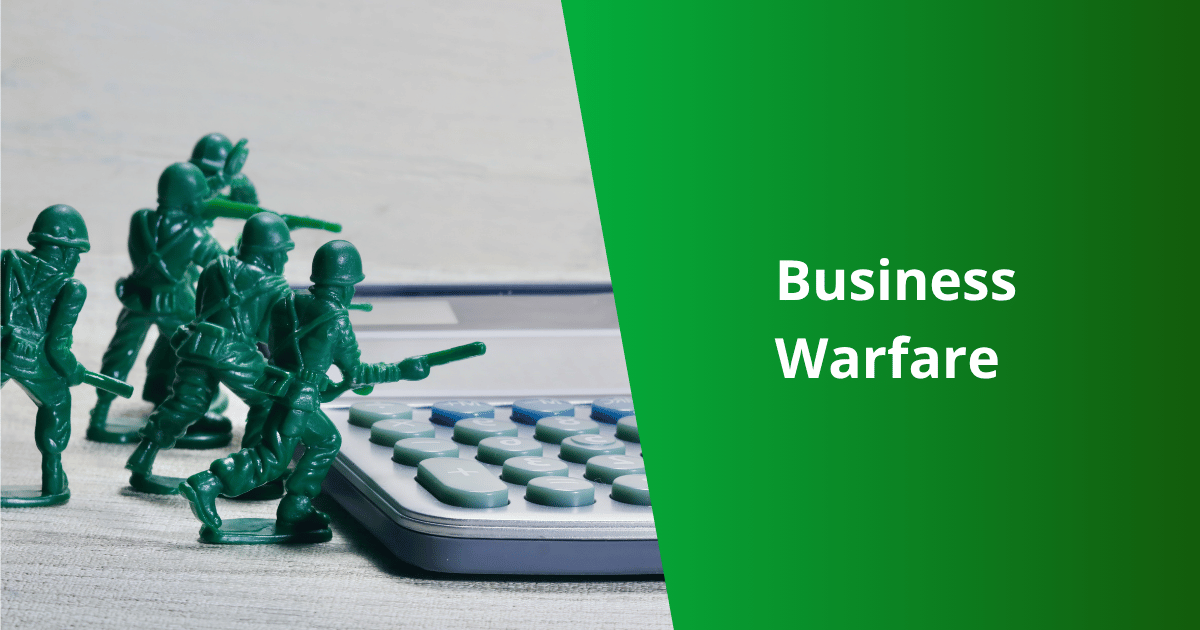
Business Warfare
A few years ago, I had the opportunity to participate in a study programme based on Sun Tzu’s The Art of War. The programme explored how the principles of ancient warfare could be interpreted and applied to modern business.
Until then, I had viewed strategy largely through the familiar language of management—targets, budgets, market share, competitive analysis and annual plans.
Sun Tzu introduced me to a very different way of thinking. Strategy was not simply about creating a plan and following it. It was about understanding people, anticipating movement, recognising changing conditions and knowing when to act—or when not to act.
The course was deeply revealing. It influenced the way I began approaching marketing, management, competition and decision-making. It also made me realise that business strategy, much like warfare, is not conducted in a stable environment.
Competitors move. Customers change their minds. Technologies disrupt established models. Employees react emotionally to uncertainty. Governments introduce new regulations. Economic conditions alter demand. A carefully prepared strategy can therefore become outdated almost as soon as it is written.
This is why the comparison between warfare and business can be useful—provided we interpret it carefully.
Business warfare does not mean treating competitors as enemies who must be destroyed. Nor does it mean encouraging aggression, manipulation or hostility. It means recognising that business operates in a dynamic environment where information, timing, adaptability and human behaviour often determine the outcome.
The Plan Is Already Ageing
Modern military thinking places enormous importance on reducing the time required to understand a situation, make decisions and act. At the same time, an army attempts to disrupt its opponent’s ability to do the same.
The underlying lesson is simple: speed of understanding can be more valuable than size of resources.
A strategic plan may look impressive in a conference room, but the world outside continues to change while the presentation is being prepared. By the time the document has passed through multiple reviews and approvals, some of its assumptions may no longer be valid.
Businesses often create annual strategies based on familiar sources of information:
- Financial performance trends
- Profitability of individual products or service areas
- Evaluation of current and previous strategies
- Comparisons with competitors
- Historical sales and operating data
All this information is valuable. A company must understand its finances, know which products generate profits and learn from earlier decisions.
But there is a danger.
Most of this information tells us what has already happened. It is similar to studying the result of the previous battle without asking how the battlefield itself is changing.
Looking at last year’s turnover may tell a retailer which category performed well. It does not necessarily reveal whether customers will continue buying that category next year. Studying past margins may explain which product was profitable, but it may not reveal that a new competitor, technology or customer preference is about to make that product less relevant.
Historical information is often more useful for scorekeeping than for strategy.
The Comfort of the Rear-View Mirror
Human beings naturally look to the past when making decisions. The past feels concrete. It provides numbers, examples and experiences. The future, by contrast, is uncertain and uncomfortable.
This preference for certainty appears in both social and business environments.
In our personal lives, we often assume that what worked earlier will continue to work. We repeat familiar behaviours, rely on established relationships and resist information that challenges our existing beliefs. Organisations behave in much the same way.
A successful company may continue using the same advertising approach because it worked for many years. A retailer may keep stocking the same merchandise because those products were once popular. A manager may continue leading employees through authority and control because that method delivered results in an earlier environment.
The problem is not that these approaches were wrong. The problem is that conditions may have changed.
There is an appropriate analogy: if we drove a car in the same way many organisations are managed—with our eyes fixed firmly on the rear-view mirror rather than looking through the windscreen—there would be accidents at every corner.
The rear-view mirror is necessary. It shows us where we have come from. But it cannot show us clearly where we are going.
Strategy requires both memory and imagination.
Knowing the Changing Battlefield
Many companies say they want to become future-ready, yet their strategy processes remain heavily inward-looking.
They organise strategy retreats, conduct SWOT analyses, review market positioning, hire external consultants and circulate employee surveys. These tools can certainly generate useful conversations. However, they often become rituals rather than instruments of discovery.
People gather in a conference room, discuss familiar problems, prepare a presentation and produce a list of initiatives. Everyone returns to work feeling that strategy has been completed for another year.
But real strategy is not an annual event. It is a continuing habit of observation.
Businesses must constantly ask:
What is changing around us? What are customers beginning to value differently? Which assumptions about our market may no longer be true? What new behaviour is technology encouraging? Where might a competitor come from that we do not yet consider a competitor?
A traditional clothing retailer, for example, may believe that its competition consists only of other stores in the neighbourhood. In reality, it may also be competing with online marketplaces, direct-to-consumer brands, rental services, changing office dress codes and customers choosing to spend more on experiences than on clothing.
The battlefield has expanded, even if the shop has not moved.
Similarly, a restaurant may study the menu and prices of nearby restaurants while ignoring food-delivery platforms, home chefs, health-conscious eating habits and the growing customer preference for convenience. By the time these changes become visible in the financial statements, the strategic shift may already be well underway.
Good strategy therefore depends on addressing weak signals—small indications of what may become important tomorrow.
The Human Side of Strategy
Business warfare is ultimately shaped by human behaviour.
Customers are not predictable machines. Employees do not respond only to incentives. Competitors do not always behave rationally. Leaders themselves are influenced by ego, fear, overconfidence and attachment to earlier success.
A company may possess accurate market information and still fail to act because its leaders do not want to accept what the information suggests.
This is where organisational culture becomes a strategic factor.
Can employees question established assumptions without being punished? Can someone from the shop floor tell senior management that customer behaviour is changing? Can a sales executive admit that an old product is losing relevance? Can leaders change direction without treating the change as an admission of personal failure?
An organisation that silences uncomfortable information may appear united, but it is strategically blind.
Military commanders need reliable intelligence from the field. Business leaders need the same. Frontline employees, salespeople, customer-service teams, distributors and store managers often observe changes long before those changes appear in formal reports.
A salesperson may notice that customers are asking different questions. A store employee may observe that people are touching a product but not buying it. A customer-service executive may detect a repeated frustration. Individually, these observations may seem insignificant. Collectively, they may signal an important change in the market.
The quality of strategy depends not only on the availability of information, but also on whether people feel safe enough to communicate it.
From Fixed Plans to Strategic Readiness
The greatest strategic challenge for businesses today is balancing short-term performance with long-term relevance.
Leaders face increasing customer expectations, pressure on margins, aggressive competition and the constant need to deliver quarterly results. They must protect current profitability while investing in capabilities that may only generate returns in the future.
Under such pressure, financial performance naturally dominates attention. Yet financial measures are mostly outcomes. They tell us the result of earlier decisions.
They do not always tell us whether the organisation is prepared for the next change.
Strategic readiness requires businesses to develop several disciplines.
First, leaders must understand the trends influencing their markets. These may include technology, regulation, demographics, social values, customer habits and economic conditions.
Second, they must identify the information that needs to be tracked continuously. Data should not merely be collected; it must reach the people who can interpret and act upon it.
Third, businesses should expand their strategic toolbox. Financial analysis and SWOT exercises should be supported by scenario planning, cultural assessment, customer-behaviour analysis and an honest study of the profit and growth potential of different business areas.
Fourth, organisations must improve their ability to make decisions quickly. Speed does not mean recklessness. It means creating clarity about who decides, what information is required and how action will be coordinated when conditions change.
Finally, companies need an accurate understanding of their people’s capabilities. Skill maps can reveal what knowledge exists within the organisation, where critical gaps remain and which employees may be prepared for larger responsibilities.
A strategy cannot be executed merely through PowerPoint slides. It must be supported by people who possess the necessary skills, confidence and authority.
Winning Without Fighting
One of the most powerful ideas associated with Sun Tzu is that the highest form of victory is achieved without unnecessary battle.
In business, this could mean avoiding a destructive price war by creating a distinctive customer experience. It could mean serving an overlooked market rather than fighting established competitors for the same customers. It could mean building trust, convenience or expertise that competitors find difficult to copy.
A fabric retailer, for instance, may not be able to compete with large online platforms on assortment or discounts. But it can compete through personalised advice, reliable tailoring, fabric knowledge and long-term customer relationships. Instead of entering the opponent’s strongest territory, it chooses a battlefield where its own strengths matter.
This is strategy—not aggression.
The purpose of business warfare is not to become permanently combative. It is to develop awareness. It is to understand that markets move, people behave emotionally and advantages are rarely permanent.
The strongest organisation is not necessarily the one with the largest budget, the most employees or the longest history. It is the one that notices change early, learns without defensiveness and responds without unnecessary delay.
Charles Darwin is often paraphrased as saying that survival belongs neither to the strongest nor to the most intelligent, but to those most responsive to change. That idea lies at the heart of both evolution and strategy.
Past performance deserves to be studied, but it should never become a prison. A business must occasionally turn away from the rear-view mirror, look through the windscreen and ask the most important strategic question of all:
What is changing—and are we prepared to change with it?